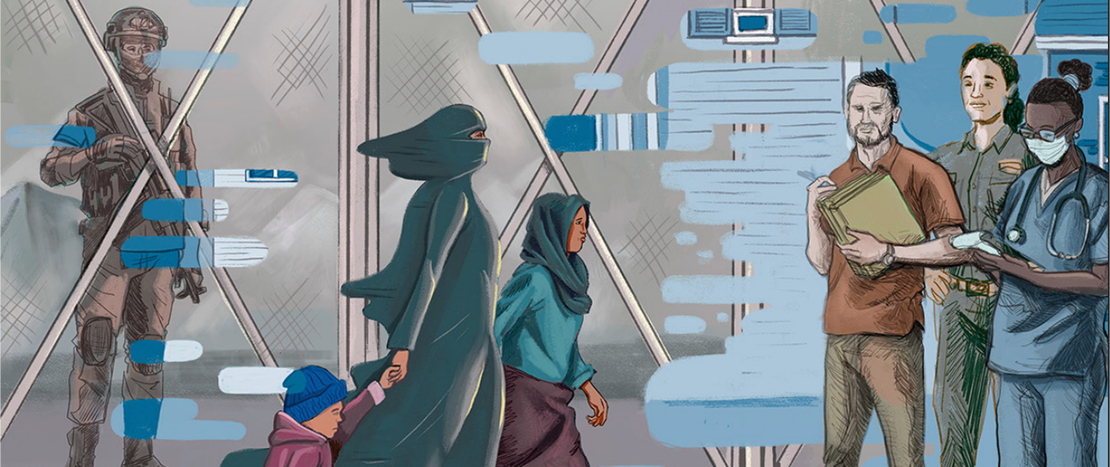
The repatriation & reintegration dilemma: How states manage the return of foreign terrorist fighters & their families
- Haroro Ingram , Julie Coleman , Austin Doctor , Devorah Margolin
- Reintegration , Ftfs
- June 2022
Table of Contents
Examines factors which drive states’ approaches to reintegration of FTFs and their families.
Abstract
This study analyzes the interplay of factors which drive states’ approaches to the repatriation and reintegration of Foreign Terrorist Fighters (FTFs) and their family members. The literature is dominated by descriptive studies of state policies that tend to explain states’ failure to repatriate and reintegrate citizens as the result of deference to governments’ national security decisions. Our study builds on these foundations to offer the scholarly and policy fields both a framework to explain why governments adopt distinct policy postures, and a means to enable these same actors to engage in more systematic analysis and development of repatriation and reintegration policy. This study argues that a balance of four considerations are crucial for explaining state behavior in this policy context: (i.) the scope of the issue, including the number of citizens considered FTFs or affiliated persons, geographic proximity, and access to the conflict, (ii.) existing legal basis for repatriation and reintegration, (iii.) instrumentalization for institution building, and (iv.) programming strategy for repatriation and reintegration. As a pilot study, this paper applies the framework to assess cases of the United States, the Netherlands, Kosovo, and Iraq. As FTF management issues are not a relic of the recent past but a persistent policy concern that warrants more nuanced and forward-looking attention, this study also considers the continued application of the framework to explore the different ways in which states may balance these four considerations in policy design and practice in the future.
FTF management issues are not a relic of the recent past but a persistent policy concern that warrants more nuanced and forward-looking attention.
Full Paper
Follow link below for the paper. Questions? Contact the authors.
Full PaperTags :
Share :
Related Posts

Homegrown: U.S. federal cases against ISIS
- Seamus Hughes , Callie Vitro , Camden Carmichael , Mackenzie Harms , Austin Doctor
- Isis, Courts, Hgve
The current state of U.S. federal cases against ISIS
Read MoreThe mobility of terror: Examining the decision to travel or remain home in US ISIS cases from 2014-2025
The decision to travel versus remain home for ISIS-affiliated defendants in U.S. federal courts.
Read More
Older and wiser: How terrorist leaders’ tenure influences tactical decisions
Understanding the impact of leader tenure and role on group operations.
Read More